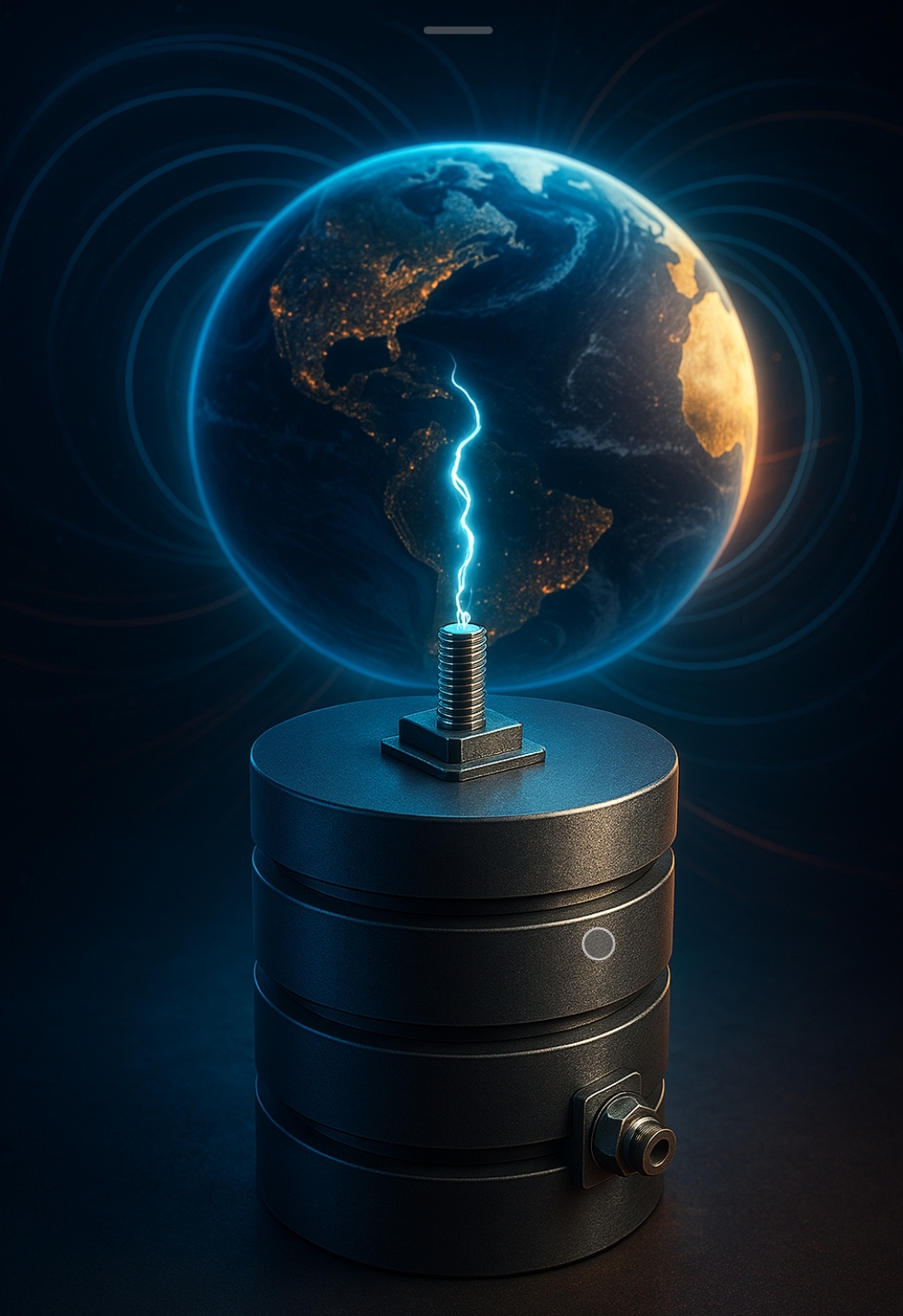







In a groundbreaking experiment, researchers from Princeton University and NASA’s Jet Propulsion Laboratory (JPL) have developed a device that can generate electricity from Earth’s rotation. This discovery challenges previous scientific assumptions and opens up new possibilities for sustainable energy harvesting.
Understanding the importance of this discovery is a crucial step towards our swift to renewable energy sources. The researchers work demonstrates that it is possible to harness sustainable energy from not just our, but any planet’s motion. If this technology is scaled effectively it can reshape the field of energy research, and could be useful even in remote locations, such as the space missions where harnessing ambient energy is crucial for long-term sustainability. Moreover, this discovery could play a crucial role in future efforts to colonize other planets.
Energy from Earth’s rotation has long been considered as impossible to harvest. Previous theories suggested that extracting electricity from the motion of our planet’s rotation, with a device stationary in respect to Earth is not accomplishable. These theories stated, that the extracted electrons would rapidly displace. This is due to the effect generated by electric field that cancels the magnetic force therefore the generated electric current can not be sustained.
However, Scientists Christopher Chyba from Princeton and Kevin Hand from JPL revisited the matter, and identified ways to overcome these limitations.
The scientist found, that Manganese–Zinc Ferrite holds special magnetic properties making the perfect cancellation impossible. To test this theory, they proceeded to build a hollow cylinder from MnZn, and positioned this cylinder in a perpendicular to both Earth’s rotational axis and it’s magnetic field and the scientist were able to successfully generate and sustain a small, but consistent amount of electricity of an approximate 17 microvolts.
“The device appeared to violate the conclusion that any conductor at rest with respect to Earth’s surface cannot generate power from its magnetic field,”
Reported by Chyba
This experiment was conducted in a room with the lowest possible influence from other devices that could generate electric current, in a completely dark room, to maximise the accuracy of the measuring device. Furthermore, the shown voltage magnitude and behaviour was previously predicted by the scientists, further demonstrating that the observed effect is not due to an unidentified local influence.
It is important to mention that the current output is incredibly low, and is not fit for any practical use therefore further research is still required to enhance the efficiency of the machine’s energy extraction.
This discovery is more than just another form of renewable electricity source, but represents an exciting new field within energy research.The possibility to harness planets natural motion for power generation is now proven to be feasible. This pioneering work reminds us that even long held scientific assumptions can be disproven, and points out the importance of revisiting such theories. Nonetheless Christopher Chyba ‘s and Kevin Hand’s work remains an innovative breakthrough with the potential to reshape the future of energy.
You can read the full research by clicking here

Subscribe to continue reading
Subscribe to get access to the rest of this post and other subscriber-only content.