






In today’s rapidly advancing world, groundbreaking discoveries are announced frequently, making it rare for one to stand out as truly extraordinary. However, Microsoft has still managed to captivate the scientific community with its latest announcement, unveiling a remarkable innovation that pushes the boundaries modern science.
Understanding states of matter
Most of us are familiar with the common states of matter—solid, liquid, gas, and some even with plasma—which are defined by how atoms are arranged, respond to deformations, and react to environmental changes such as heat. But since the discovery of these states, scientists have identified further exotic forms of matter that exist only under extreme conditions, while others remain purely theoretical, pending experimental verification.
Topological States
One of these aforementioned exotic forms are the topological states which can not be defined by the standard symmetry-breaking theories. Topological states are rather distinguished by their global properties, which remain unchanged under smooth deformations like stretching or bending. These states arise from the quantum mechanical behavior of particles, especially in systems constrained to low dimensions or under specific conditions like extreme cold or high magnetic fields. In the realm of modern physics, the discovery of these states marked a significant advancement in quantum theory and in our understanding the phases of matter.
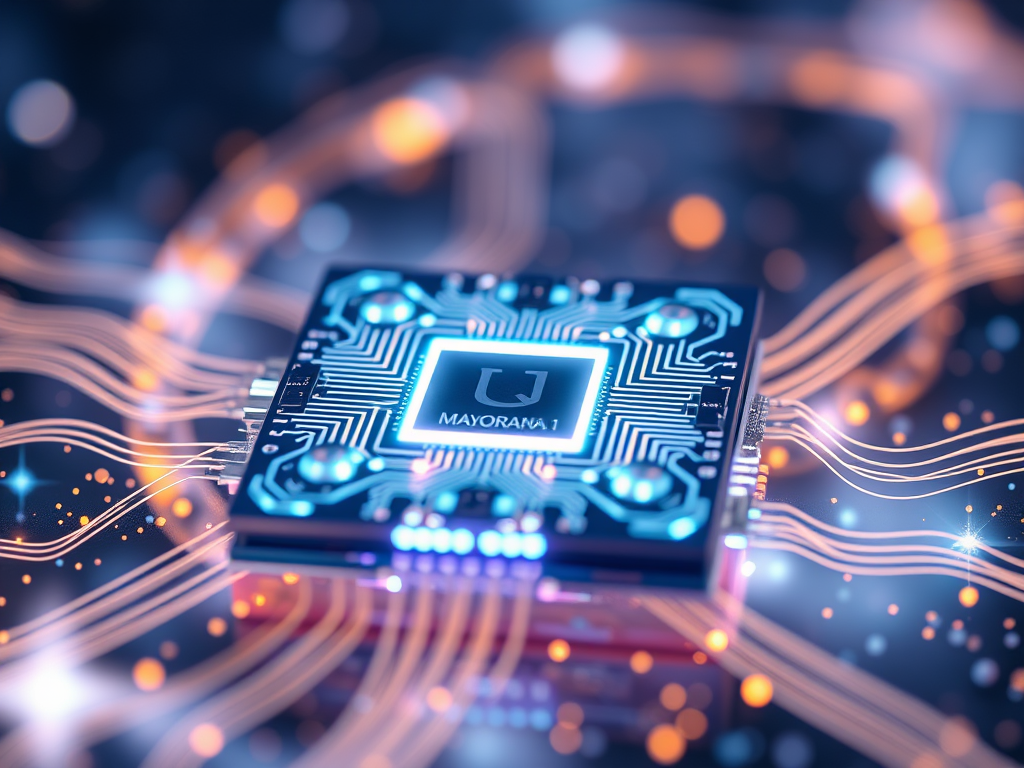
Microsoft’s recent discovery signifies another major step forward in the race toward quantum computing by creating a new chip called Majorana 1. With the creation of this innovative chip, the organization has also discovered an entirely new state of matter called a topological superconductor and utilized it. This rare and unusual form of matter enables scientists to develop more stable, faster, and scale-able quantum computers.
Majorana Zero
This state requires an artificial environment, since the likelihood of its natural occurrence is extremely low. A topological superconductor forms when certain materials such as the combination of indium-arsenide and aluminum, are combined and cooled nearly to absolute zero while being exposed to a magnetic field.
These extreme conditions allows the hosting of a special quantum particle, called Majorana zero modes, where a rare behavior in physics takes place- a so called anti particles forms simultaneously with its counterpart. Due to this unusual formation, Majorana modes are predicted to be robust against local disturbances, making them promising candidates for building fault tolerant quantum computers.
This state requires an artificial environment, since the likelihood of its natural occurrence is extremely low. A topological superconductor forms when certain materials such as the combination of indium-arsenide and aluminum, are combined and cooled nearly to absolute zero while being exposed to a magnetic field.
These extreme conditions allows the hosting of a special quantum particle, called Majorana zero modes, where a rare behavior in physics takes place- a so called anti particles forms simultaneously with its counterpart. Due to this unusual formation, Majorana modes are predicted to be robust against local disturbances, making them promising candidates for building fault tolerant quantum computers.
In quantum computing the information is stored in qubits as opposed to bits used by traditional computers to transfer and store data. These qubits are extremely sensitive to their environment, meaning that any local disturbance could disrupt the flow of the information or completely terminate it. Topology, and topological formations are crucial in quantum physic due to their robustness and ability to undergo continuous deformations while their structure remains unchanged.
Furthermore, these modes‘ have properties that are inherently stable against any kind of physical imperfections, resulting in significantly lower chances of errs. Microsoft has leveraged the power of these particles to create the Majorana 1 chip. While the chip currently utilizes only 8 of these qubits, it has been designed to scale up to millions on a single chip, potentially elevating the power of quantum computers to the point where we could crack current encryption methods and enable the development of new quantum-safe alternatives
The discovery of topological states challenge traditional notions, opens a new field for advancing quantum computing, and simultaneously, offering new possibilities to elevate the current technology. While there is still much to explore, if Microsoft successfully leverages the power of this new material state, its applications could bring truly powerful quantum computers into reality sooner than expected

Subscribe to continue reading
Subscribe to get access to the rest of this post and other subscriber-only content.