





In March, China gained international prominence when the public observed a human-sized android police officer patrolling the streets of Shenzhen City. Deployed by EngineAI, the humanoid android, standing 1.38 meters tall and weighing approximately 40 kilograms, has been observed shaking hands, assisting with public interactions and police patrols and helping officers identify individuals using its built-in facial recognition technology.
Founded by Zhao Tongyang in October, 2023, the Shenzhen-based startup targets researchers, developers, businesses, and governmental institutions where automation is a viable option. The PM01 is a compact bipedal humanoid robot developed by EngineAI, originally intended for private use. The android is equipped with advanced features, including a 320-degree waist rotation, facial recognition, and high-tech sensors for spatial awareness and navigation, enabling the organization to extend its applications beyond initial plans into law enforcement and education.In its core, an interactive screen allowing the operator to display or receive information, give touch-based commands or even guide the observers via written messages.
PM01 © 2025 by EngineAI is licensed under CC BY-ND 4.0
Between it’s official market launch on December 24, 2024, and March, 2025, the unified price of ¥88,000 (approximately $12,000) was considered affordable and well-suited for commercial settings. During this development stage, updates with additional educational features were implemented, and the final commercial version was released. The price of the new updated PM01 version is set at an astonishing ¥188,000 ($26,000), more than double the cost of previously purchased units, which all received these upgrades free of charge.
PM01‘s rapid deployment in March 2025 in the police force marked it as a pioneering android, noted for its human-like interactions. While currently in a testing phase rather than full operational duty as it requires supervision and constant charging stations due to its limited functionality and two-hour battery life, it is already assigned several duties to perform.
The humanoid is responsible for patrolling public spaces, aiding environmental awareness and interacting with citizens through gestures like shaking hands, waving, and responding to voice commands, as seen in videos from the Shenzhen Tourist Information Center. Armed with an Intel RealSense depth camera and facial recognition, the humanoid monitors crowds while walking at a speed of 2 m/s (4.5 mph), accompanied by human police officers and wearing high-visibility police vests to enhance its visibility and signal its role as a law enforcement assistant.While no information has been publicly released about the number of units to be deployed within the Shenzhen Police Force, EngineAI’s plans confirm the production of over 1,000 units by the end of 2025, suggesting potential mass deployment.
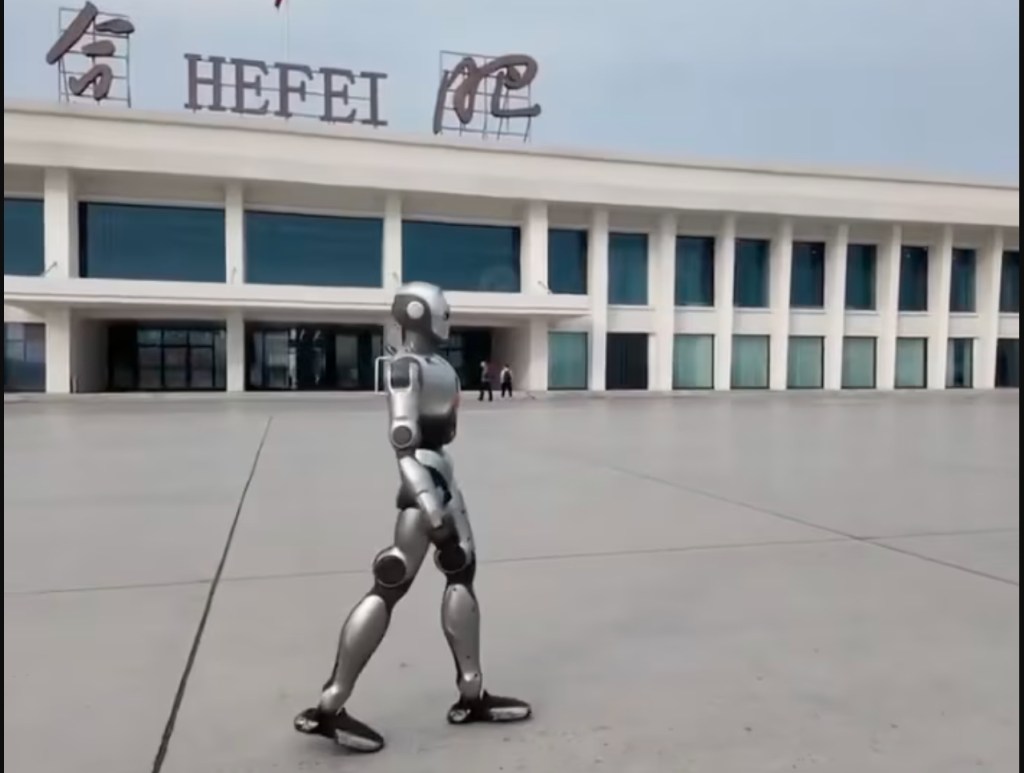
PM01 © 2025 by EngineAI is licensed under CC BY-ND 4.0
The PM01 serves as a showcase of Shenzhen’s technological prowess, captivating crowds and drawing media attention, as reported by outlets like Interesting Engineering and NDTV. Public demonstrations, such as at the Shenzhen Bay Innovation and Technology Center, highlight its agility (e.g., performing a frontflip) and human-like movements, aligning with China’s goal of integrating sci-fi-inspired robotics into daily life.
Related Updates in Humanoid Robotics
Thailand’s AI Police Cyborg 1.0, dubbed ROBOCOP 01, was deployed on April 16, 2025, however it operates on a wheeled platform, unlike the bipedal PM01. Equipped with 360° cameras and facial recognition, it’s intent is to surveil festivals and monitor crowds.
In 2017, a stationary humanoid robot was deployed in Dubai. Due to its lack of agility and patrol capabilities, its primary focus remained mall assistance

Subscribe to continue reading
Subscribe to get access to the rest of this post and other subscriber-only content.