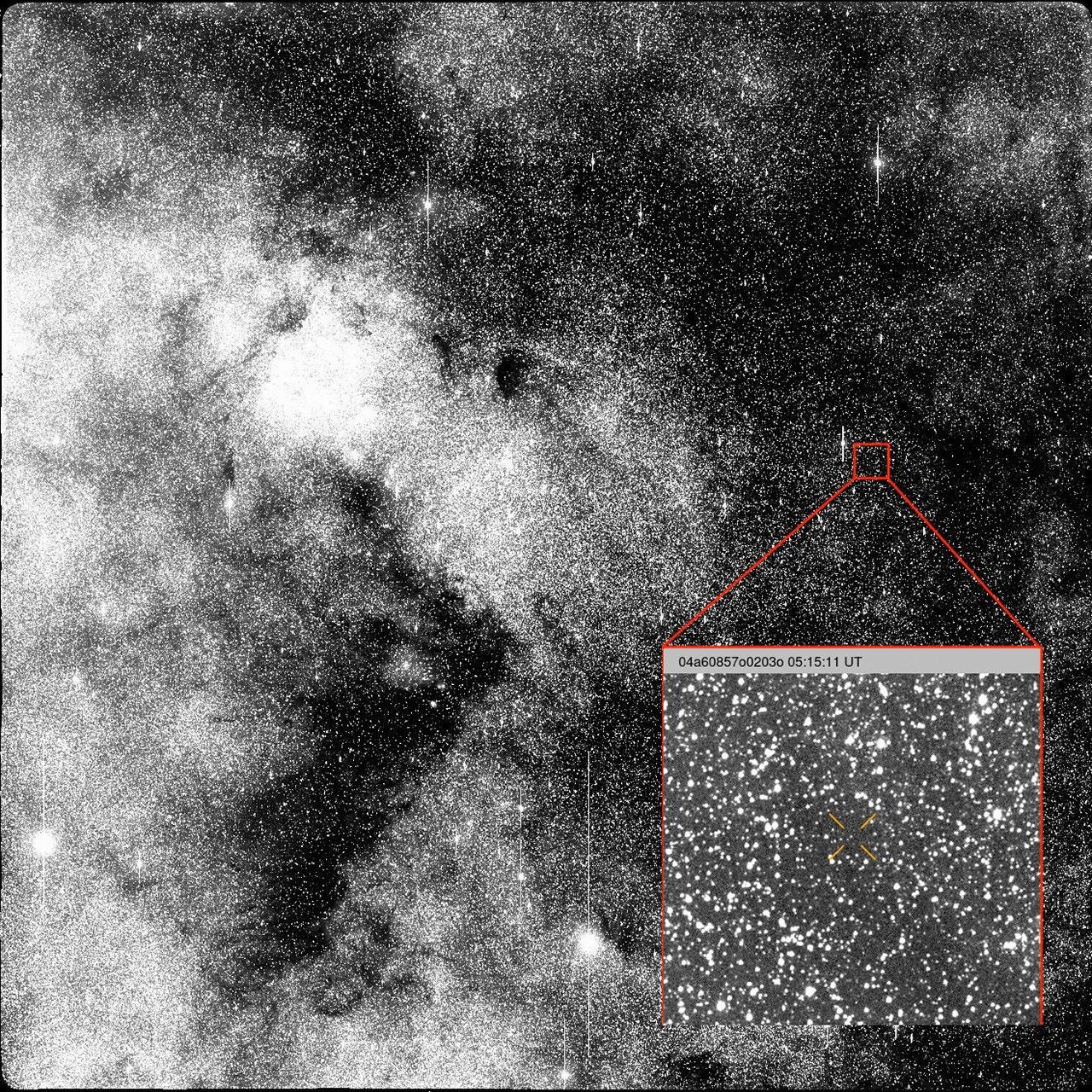






In early May, 2025 Nasa’s Atlas telescopes worldwide, together with Caltech’s Zwinsky Transient Facility at Palomar Observatory, detected what appeared to be an early commentary activity close to the sun. At fist the object was though to be a typical asteroid, but its unusual behaviour prompted scientists to investigate further in order to determine its trajectory and direction.
As the investigation advanced, researchers from the Asteroid Terrestrial-impact Last Alert System (ATLAS) turned their attention to the 29-27 pre-discovery images, and began surveying the surrounding region of the Sun for additional evidence. Their efforts culminated on July 1st, 2025, when the object was finally detected using the instruments at Chile’s W68 Rio Hurtado Observatory .

Comet3I-ATLAS. © 2025 by NASA is licensed under CC BY 4.0

After a throughout investigation, the team of scientists classified the object as an active comet, featuring a solid icy nucleus surrounded by a coma (cloud of gas and dust) with a reddish hue indicative of large dust grains and long exposure to cosmic rays. The researchers also comfirmed that the nucleus originated from internal space, likely near the Milky Way’s Galactic center, possibly from the galaxy’s thick disk, and it could be at least seven billion years old. It was found to follow a hyperbolic orbit with an eccentricity of about 6.139, traveling at an excess velocity of roughly about 58km/s relative to the Sun. These findings led to its provisional designation as 3I/ATLAS -3rd Interstellar- marking it as the third comfirmed interstellar object ever detected in our solar system which passes though on a hyperbolic tragectory without being bound by the Sun’s gravity at all.
Compositionally, the comet it speculated to be rich in carbon dioxide (CO2), with smaller amounts of water ice, water vapor, carbon monoxide (CO), and carbonyl sulfide (OCS), along with traces of cyanide gas and atomic nickel vapor. Its diffuse coma spans approximately 26,400 by 24,700 kilometers, and as of September 1 , it is approaching the inner Solar System on course for its periphelion. Notably the comet will approach Mars at 0.1936 AU on October 3, pass by Venus at 0.6494 AU exactly a month later on November 3, make a more distant approach to Earth at 1.797 AU on December 19 and finally fly past Jupiter at 0.359 AU on March 16, 2026. These observations have been made possible though multiple instruments, including the Hubble Space Telescope on 21st of July 2025, the James Webb Space Telescope and SPHEREx Mission, and ground based facilities such as the Gran Telescopio Canarias and Nasa’s Infrared Telescope Fascility.
Over 539 observations were collected from a wide range of scientific instruments, over an 82 -day arc, and during the review of this data scientists began to notice several anomalies. These included a Sun-facing dust plume (unusual, since cometary tails typically point away from the Sun), an exceptionally high CO2-to-H2O mixing ratio and the absence of a bring water coma despite the comet’s proximity to the water-ice line. Consequently, Harvard Astronomer Abraham Loeb, together with Adam Hibberd and Adam Ceowl of the Initiative for Interstellar Studies (I4IS), proposed the provocative hypothesis that 3I/ATLAS might in fact be an artificial extraterrestrial spacecraft.

Comet-3I-ATLAS © 2025 by NASA is licensed under CC BY 4.0
Harvard’s Hypothesis – Advanced Propulsion and Alien Intelligence
The group of scientists from I4IS along with Harvard Astronomer Loeb then published a paper titled as “Is the Interstellar Object 3I/ATLAS Alien Technology” as a draft (also available via Harvard’s Center for Astrophysics Site and related to arXiv submission) also arguing that it possibly have hostile intents. The study builds upon further identified discrepencies with regular interstellar objects. The comet’s retrogate orbital plane has a low tilt to the ecliptic, making it hard for humans to intercept, but ideal for an extraterrestrial intelligence to access planets with impunity. The trajectory aligns closely with most of the solar system’s planetary plane reaching close to each one of them, suggesting a deliberately targeted enter to the inner system rather than a random entry. The exceptionally near passes by Venus, Mars and Jupiter with an overall propability ≤0.005% for natural interstellar objects, further implying possible intentional navigation. Low delta-V (<5 km/s) would be needed for intercepts or rendezvoud, feasible for an Advanced propulsion, this would also align with Extraterrestrial intelligences (ETI).

Credit: NASA / PSD
Comet%203I-ATLAS.gif © 2025 by NASA is licensed under CC BY 4.0
The researchers have also identified that the object’s acceleration is not governed by gravitational forces, a behaviour not fully explained by natural ourgassing. The measured acceleration of ~5.9 × 10⁻⁵ AU/day² (normalized at 1AU) suggest the possibility of a technological mechanism, such as photonic propulsion. Moreover, 3I/ATLAS lacks typical commentary features, such as a tail, intead, images reveal only a faint glow elongated toward the sun. Together with the other noted discrepancies, this rases the possibility of an extraterestrial technological origin, as reported by the Co-authors in the publication.
The research group also considered the “Trojan Horse” hyphothesis; that the object may appear natural through careful simulations and dynamics while concealing technology, emitting heat or signals, or manoeuvring in way that attempt to camouflage its true nature. Humanity’s recent technological advances and increasing space activity may have served as a signal to advanced civilisations.
The object will reach solar eclipse alignment from Earth‘s perspective on October 29 with a 7% propability. This opens the possibility of hidden maneuvers, such as the reverse Solar Oberth maneuver which uses the Sun’s gravity for efficient breaking in order to remain in the Solar System.
While Loeb describes this primarily as a pedagogical excercise to explore possibilities, and it is likely to be natural, it remains worth observing and testing scientifically. The research paper elaborates on this medium and ranked it 4TH on the Harvard Astronomers‘ scale of interstellar technological threats based on current data, highlighting the neccesity of further investigating to determine the phenomena behind the anomalies.
If you’d like to stay up to date on the fast-moving world of interstellar astronomy and extraterrestrial technology research, subscribe to our newsletter, or visit Harvard’s official publication and the arXiv repository for the latest updates on 3I/ATLAS and related discoveries.

Subscribe to continue reading
Subscribe to get access to the rest of this post and other subscriber-only content.