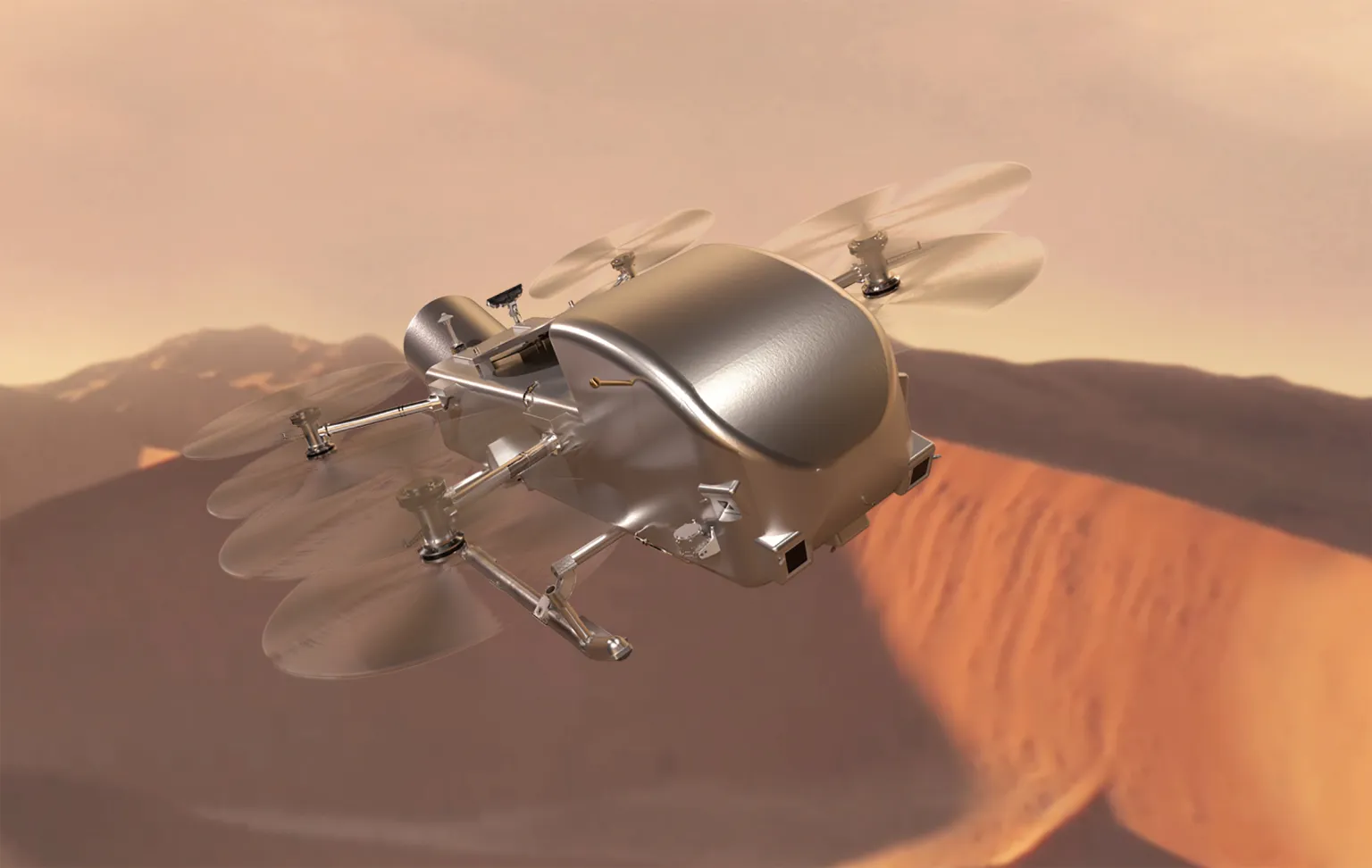







Concept of Dragonfly soaring over the dunes of Saturn’s moon Titan © 2025 by NASA/Johns Hopkins APL/Steve Gribben is licensed under CC BY-SA 4.0
NASA has been in the forefront of space exploration since it’s inception in 1958, yet in the recent years seems to have become more cautious in its risk taking preventing the organization to achieve potential breakthroughs. While Curiosity and the Perseverance rover—NASA’s two notable planetary explorers—are currently mapping parts of Mars, their missions are confined to the Gale Crater and the Jezero Crater. This rather seems to be a setback compared to the 1969 Apollo 11 mission, which successfully landed humans on the Moon. However this may simply represent a temporary developmental stage as things seem to change in the near future with their new quest in exploring Saturn’s largest, and the second largest moon in the solar system – announced by NASA on Thursday 24th of April, 2025.
NASA’s Dragonfly mission, led by Principal Investigator Elizabeth Turtle of the Johns Hopkins Applied Physics Laboratory (APL) in Laurel, Maryland, represents a groundbreaking effort in planetary exploration. The mission is part of NASA’s broader New Frontiers program, which encompasses a multitude of missions and emerging technologies. This particular voyage is proposed to last seven years with a scheduled return in 2034/5 spending over three years investigating multiple landing sites across the moon’s diverse surface and shallow subsurface for organic molecules and possible biosignatures. At its core, the mission seeks to search for signs of life and assess the habitability of Titan. Recognized for its dense atmosphere, complex and diverse carbon-rich chemistry, low gravity, and abundant water presence, the moon not only serves as a potential cradle for life to have emerged but also stands as a promising candidate to support future multi-planetary systems as humanity expands beyond Earth.
For optimal flight distance and continuous operation, the cruiser is designed with nuclear power and is connected to a Multi-Mission Radioisotope Thermoelectric Generator (MMRTG), which supplies power when recharge is needed.
The car sized rotorcraft-lander, equipped with a multitude of instruments—such as neutron spectrometers, drilling systems, and mass spectrometers, will focus on investigating prebiotic chemical processes and analyzing the planet’s atmospheric conditions . Its Dragonfly design, featuring eight rotors each measuring up to 1.3 meters, which allows the lander to cruise at speeds of around 22 mph for distances up to 10 miles, combined with its ability to climb to altitudes of up to 13,000 ft, makes it capable of visiting multiple sites on Titan to collect material and geological samples, which, when later brought back to Earth, could undergo further analysis to determine the moon’s surface composition, geological context, or the presence of life’s building blocks.
As of April 2025, all plans were approved by NASA’s Science Mission Directorate, and whether Titan is inhabited or holds the ability to support life on its surface is now up to NASA to determine. However, before we can become eyewitnesses to such an expedition, there is still some time as the mission is only scheduled for launch in 2028 from the Launch Complex 39A at NASA’s Kennedy Space Center in Florida aboard SpaceX’s Falcon Heavy rocket.
To stay up to date with current and upcoming space exploration missions, subscribe to our newsletter below.
For more information about NASA programs and missions, click here
For more information about NASA‘s Dragonfly mission, click here