






Italian scientist have achieved a groundbreaking advancement. Scientist at the National Research Council (CRN) managed to successfully transform light into a supersolid. Supersolid is a rare state of matter that combines the structural rigidity of a solid with frictionless flow of a superfluid. Before we dive deep into this new fascinating research we must establish the bases of the concept.
Understanding Supersolidity
Supersolid is an exotic phase of matter, that exhibits both crystalline order and superfluidity. When a material is cold enough, notably close to absolute zero (-459.67 degrees Fahrenheit, or -273.15 degrees Celsius) temperature no longer obscures the arrangement of the particles. The affects of quantum mechanics then becomes the defining factor, At this point the particles reach a fixed arrangement, repeating a pattern like solid, but can flow without viscosity-characteristics of superfluids. This duality has intrigued physicist since it was first theorized in 1960s with experimental confirmation emerged only in recent years , utilizing ultracold atomic gases. Iacopo Carusotto explains this phenomena as follows;
Supersolid is an exotic phase of matter, that exhibits both crystalline order and superfluidity.
When a material is cold enough, notably close to absolute zero (-459.67 degrees Fahrenheit, or -273.15 degrees Celsius) temperature no longer obscures the arrangement of the particles. The affects of quantum mechanics then becomes the defining factor, At this point the particles reach a fixed arrangement, repeating a pattern like solid, but can flow without viscosity-characteristics of superfluids. This duality has intrigued physicist since it was first theorised in 1960s with experimental confirmation emerged only in recent years , utilizing ultracold atomic gases.
Iacopo Carusotto explains this phenomena as follows;
“The droplets are able to flow through an obstacle without undergoing perturbations, maintaining their spatial arrangement and mutual distance unchanged as happens in a crystalline solid”
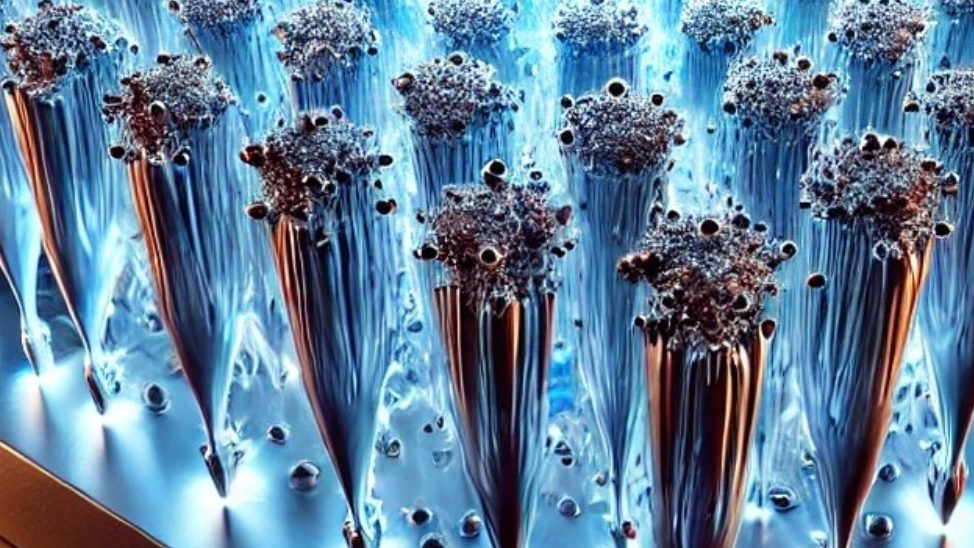
Not all materials can form supersolid, but there are some specific that has been experimentally observes or theoretically predicted to exhibit supersolidity. Certain Bose-Einstein condensates(BCEs) can form supersolid states when interactions between atoms are carefully controlled using lasers and magnetic fields.
Exotic quantum materials , that are strongly correlated electron systems might also host supersolid-like states, however this has only been theorized, and practical experiments are still ongoing to confirm it’s feasibility and explore potential applications.
Helium-4 was the first material to be supersolid, however more convincing supersolid behavior has been observed in ultracold atomic gases, such as the Dysprosium and Erbium Bose-Einstein condensates.
Helium-4 ()
The most well-known candidate, Helium-4 can theoretically enter a supersolid state at extreme low temperatures (near absolute zero) While early experiments suggested supersolidity in solid helium, later research projected that the observed effect were likely due to quantum plasticity rather than true supersolidity.
Ultracold Atomic Gases (Bose-Einstein Condensates – BECs)
Bose-Einstein condensates are a unique state of matter that occurs when a group of bosons (particles that follow BEC statics) are cooled to a temperature, very close to absolute zero. Certain CBE can form supersolid states, when interactions between atoms are carefully controlled. For this scientists use high tech lasers, and magnetic fields. Dysprosium and Erbium condensates have strong dipole-dipole interactions, which could lead to supersolid behaviours. Additionally mixtures of some two component ultracold Bose gases could also become such formations.
Optical Lattices and Artificial Systems
Other supersolid-like states have also been created using lasers to trap ultracold atoms in periodic patterns, mimicking solid structures while still allowing superfluid motion
The research was conducted by a team of Italian scientists from CRN Nanotech and University of Pavia led by Antonio Gianfrate. “Traditionally” in order to achieve supersolid states, the process includes cooling the materials down, close to absolute zero allowing the particles to arrange in a specific order. This method however, deemed unsuccessful within the research, light is not matter after all, it is energy, exhibiting both frictionless flow and solid characteristics. Therefore this experiment required the adaptation of a new approach, utilizing a gallium arsenide semiconductor structure embedded with precisely engineered microscopic cavities designed to facilitate the formation of supersolid light. The researchers then proceeded to manipulate the light within the specifically designed semiconductor platform with the aid of direct lasers. This interaction between the light and the platform led to the formation of polaritons -hybrid particles that are part light, part matters. As the number of photons increased, these polaritons organized into patterns indicative of supersolid behavior- researchers explained in a paper published in the Journal Science on 5th of March, 2025.

Significance and Future Implications
This research marks the first time, light has been observed as a supersolid, providing a new platform for exploring quantum phases of matter. The introducement of the supersolidity in light could lead to significant advancements in quantum computing, where stable qubits are essential and in the development of novel optical devices and photonic circuits. The researchers emphasize that this is just a begining of the understanding the many possible applications of light in supersolid form.
“Analyzing this exotic state of condensed matter, in a fluid of ligh, flowing in a semiconductor nanostructure will allow us to investigate it’s physical properties in a new and controlled way, and opens an opportunity to exploit it’s unique characteristics for possible applications in new light-emitting devices” added by physicist Dario Gerace
This innovative work not only deepens our comprehension of light’s properties but also paves the way for future technological breakthroughs in quantum mechanics and photonics.

Subscribe to continue reading
Subscribe to get access to the rest of this post and other subscriber-only content.