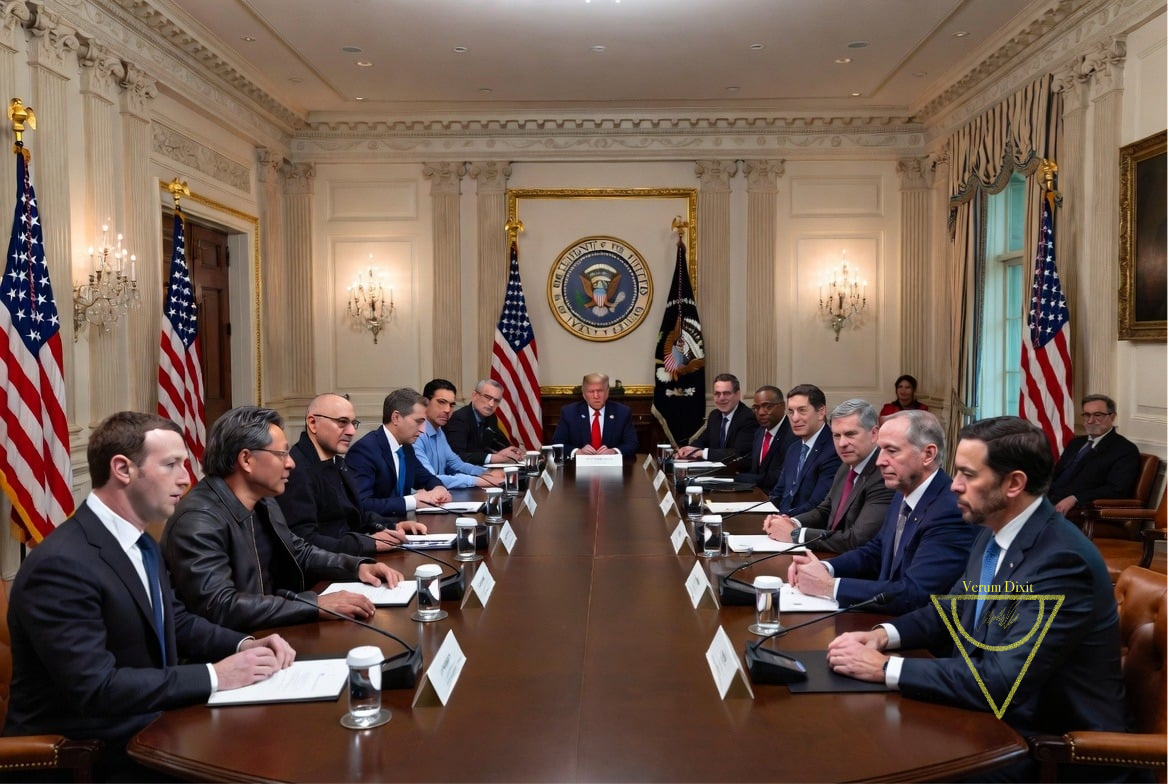


Earlier this year in January, during his second term, President Donald Trump reestablished the President’s Council of Advisors on Science and Technology (PCAST) through an executive order. The president took considerable time to evaluate the most promising candidates to fill the board, and that moment has now arrived—because as of March 25, 2026, Trump has appointed Mark Zuckerberg and Jensen Huang, CEO of Nvidia, along with 11 other tech executives as advisors to the PCAST board, the White House’s new body on science and technology policy through a press release.
The PCAST Board is a traditional board established in 1990 when it was first introduced by President George H.W. Bush through Executive Order 12700. Its purpose is to provide the president with expert advice on science, technology, and innovation policy. The board’s historical composition has primarily included distinguished scientists, physicians, engineers, and academics drawn from universities, national laboratories, and research institutions. Members have been selected for their scholarly experience and commitment to impartial, evidence-based analysis, serving without heavy industry influence to deliver non-partisan recommendations on emerging scientific challenges, public health, and long-term technological strategy.
While the newly re-established role is not a paid government position, members will be required to provide counsel to the president on any technology-related laws or policies that may be introduced or revisited, while regularly gathering to advise him with professional recommendations. Alongside Zuckerberg and Huang, tech CEOs, AI leaders, investors, and nuclear/quantum experts fill the remaining 11 seats, focusing heavily on technology and science, marking a significant shift from the previously pre-dominated academic scientists and doctors. The board will primarily focus on opportunities and challenges that emerging technologies (especially AI) present to the American workforce, in an attempt to strengthen American leadership in science and technology, according to the White House’s most recent statement. It is expected to influence AI policy, national security, economic/workforce issues, education, and U.S. competitiveness (particularly against China). Some coverage describes it as Trump’s “tech panel” for guiding AI regulation and innovation strategy. Trump has built close relationships with Silicon Valley leaders during his terms, strongly supported by the board’s appointees. Zuckerberg stated that he is “honored to join the President’s council and work with other industry leaders to help make this happen.” He also believes that the United States has the opportunity to lead the world in AI.
Full List of the PCAST Apointees
- Marc Andreessen (Andreessen Horowitz co-founder)
- Sergey Brin (Google co-founder)
- Safra Catz (Oracle Executive Vice Chair)
- Michael Dell (Dell Technologies founder)
- Jacob DeWitte (Oklo CEO – small modular nuclear reactors)
- Fred Ehrsam (Coinbase co-founder)
- Larry Ellison (Oracle Executive Chairman)
- David Friedberg (investor)
- Jensen Huang (Nvidia CEO)
- John Martinis (quantum computing expert)
- Bob Mumgaard (Commonwealth Fusion Systems CEO)
- Lisa Su (AMD CEO)
- Mark Zuckerberg (Meta CEO)
While the board is the most high-profile PCAST lineup in recent memory, consisting of tech CEOs, AI leaders, and some quantum experts, this transition from the traditional PCAST board has not been welcomed by everyone. Some critics, including Sen. Elizabeth Warren, argue that the board should typically comprise top scientists and doctors, expressing dissatisfaction with the chosen advisers. However, considering the current technological requirements, the President insists that they are the best choices for this initial round, as the appointees signal a pro-innovation, industry-heavy approach to tech policy rather than heavy regulation. He later plans to fill additional seats with experts and scientists in the field. Surprisingly, Elon Musk was not included in the initial slate, yet this could change at any moment when Trump decides to further expand the board. The council is expected to have real influence on the White House’s AI and tech decisions as well as workforce policy.
To stay informed about the PCAST board’s reports, recommendations and the policies it may influence, subscribe to our newsletter for in-depth analysis and ongoing coverage, or head straight to the White House’s dedicated reference page by clicking here.

Subscribe to continue reading
Subscribe to get access to the rest of this post and other subscriber-only content.