







A groundbreaking study, led by Dr. Zixiao Yang and Professor Maria McNamara from University College Cork (UCC) provides us new insights to the evolution of dinosaurs. The discovery of a well-preserved piece of skin from the feathered dinosaur Psittacosaurus, has unveiled remarkable details about the skin structure and evolution of these ancient creatures, published in a research paper by Nature Communications in May 2024,
The term “dinosaur mummy” refers to certain fossils, where skin and soft tissues are preserved well enough, so it can be observed. These specimens are very rare however, provide valuable glimpse into the external features of dinosaurs, that bones alone could not provide. The analysis, for instance, the Dakota’s skin, suggested that Hadrosaurs had a more robust, musculature structure than previously believed. The texture and the pattern of the skin impressions have already provided us countless clues about the possible appearance, living conditions and evolution of dinosaurs. These preserved skins also allows scientist to study the arrangement of scales and other integumentary structures, offering insight into the evolutionary relationships between different species and their modern descendants, such as birds themself.
The “Dakota” Hadrosaur Mummy
One of the most remarkable discoveries is the “Dakota” specimen, a 67-million-year-old hadrosaur found in North Dakota. Discovered in 1999 by then-teenage paleontologist Tyler Lyson on his family’s property, Dakota is an exceptionally preserved “dinosaur mummy” with much of its tissues and bones still encased in an uncollapsed envelope of skin. The excavation was led by Phillip Manning, a paleontologist at Britain’s University of Manchester and a National Geographic Expeditions Council grantee. Preliminary studies of Dakota’s fossilized skin revealed a three-dimensional skin envelope around the tail, arms, and legs, providing unprecedented insights into the dinosaur’s physical characteristics. The preservation was so detailed that it allowed scientists to study the texture and pattern of the skin, offering clues about the dinosaur’s appearance and potentially its coloration. Additionally, analysis of Dakota’s musculature suggested that Hadrosaurs were more muscular than previously thought, potentially capable of running faster than the formidable Tyrannosaurus rex.
Jurassic Skin Impressions
In the Jurassic rock of Colorado’s Morrison Formation, paleontologists John Foster and Rebecca Hunt–Foster reported the discovery of three distinct skin specimens. Two of these were thin, carbonized patches found near sauropod bones, suggesting they belonged to long-necked dinosaurs like Apatosaurus, Camarasaurus, or Diplodocus. The third specimen, though indeterminate in origin, displayed the pebbly texture characteristic of dinosaur skin. These findings, detailed in the Journal of Vertebrate Paleontology in 2011, highlight the delicate nature of skin impressions and the specific conditions required for their preservation. The researchers hypothesized that the unique environmental factors of the site, including acidic conditions and bacterial activity, may have contributed to the exceptional preservation of these skin traces.
Oldest Fossilized Skin
In a cave system at Richards Spur, Oklahoma, paleontologists uncovered fossilized skin impressions dating back approximately 288 million years, making them the oldest known examples of fossilized skin. Described in Current Biology in 2023 by Ethan Mooney and colleagues, these impressions belonged to early amniotes—lizard-like creatures among the first to live entirely on land. The skin displayed a pebbly, scaly texture similar to modern crocodiles, providing insights into the evolution of terrestrial adaptations in vertebrates. The exceptional preservation was attributed to a unique combination of factors, including the interaction between clay-rich sediment, low oxygen levels, and hydrocarbon seepage within the cave environment.
The specimen –NJUES-10 was donated to Nanjing University in 2021, and the unfossilized skin remained undiscovered for the upcoming years due to it being invisible under natural light. The researchers initially observed the fossil under ultraviolet illumination (UV) which emitted a striking orange-yellow fluorescent colour, allowing them to identify and later analyze the preserved tissue.

Remarkable discovery – Unfossilized “rubbery” Dinosaur Skin found preserved in a millennia-old fossil © 2025 is licensed under CC BY-SA 4.0
Then, the scientist proceeded to investigate the specimen using X-rays and infrared light which further unveiled the detailed cellular structures within the skin. A prime discovery was the skin’s composition; it was found to be mineralised with silica, -main component of glass.- This type of preservation is unprecedented in previously observed vertebrate fossils and has left the researchers with a great suprise.
The finding offers significant implications for understanding the evolutionary transition from scales to feathers in dinosaurs. Dr. Yang’s and Professor McNamara’s research revealed a pattern of “zoned Developement” in the species’s skin, featuring areas of reptiles like scales and of bird-like skin, latest associated with feathers. The presence of these scaly skin in soft regions indicates that early feathered dinosaurs retained reptilian skin characteristics while developing feather like features. This stage of the developement was crucial to maintain protection against abrasion and parasites, while supporting the survival and evolutionary progression of the ancient speices.
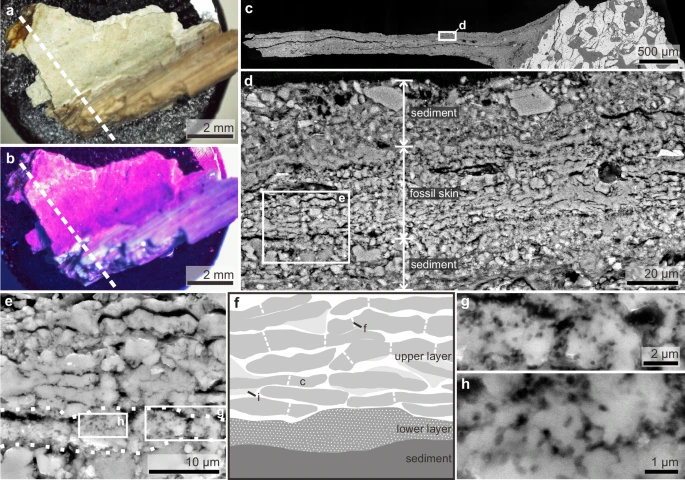
Remarkable discovery – Unfossilized “rubbery” Dinosaur Skin found preserved in a millennia-old fossil © 2025 is licensed under CC BY-SA 4.0
Well preserved dinosaur skins are of an extremely rare occurrence. The process of preservation requires exceptional conditions to prevent the tissue’s decomposition. Scientists suggest that rapid burial in sediment–rich environments, such as floodplains and river deltas could offer protection to the carcasses from scavengers and decay allowing slow preservation of the soft tissue.
Another hypothesis suggest that desiccation and deflation could cause these carcass remain’s skin to dry out, due to it being exposed long enough before being buried, as in the case of the Dakota Specimen -studies revealed.
The unearthing of these unfossilized soft tissues, and “mummies” to date have significantly shaped our understanding of the biology and living conditions of dinosaurs. The recent discovery follows upon earlier findings of soft tissues in dinosaur fossils such as the discovery of collagen fibers in a Tyrannosaurus Rex’s leg bone in 2005 by Dr.Mary Schweitzer, and a similar study in 2015, where scientists from the Imperial College London identified red blood cells and collagen fibers in a 75 million year old dinosaur bone.
“There are potentially many more fossils with hidden soft tissues awaiting discovery.”
noted by Dr. Yang
While the UCC-led research underscore the importance to uncover hidden soft tissues in existing fossil collections, they also serve as exceptional piece of clue to offering new avenues to explore dinosaur physiology,evolution and the intricate events that led to the disappearance of these ancient creatures.
You can read the original study by clicking here

Subscribe to continue reading
Subscribe to get access to the rest of this post and other subscriber-only content.