
Scientific breakthrough, or just another hoax? Colossal Biosciences left the the global scientist community puzzled over their most recent announcement. The firm alleges that it has resurrected an iconic predator extinct for over 12,000 years. Backed up with images of shaggy, white-coated pups , the claim sparked awe, skepticism and above all a heated scientific debate!
The Canis Dirus
Canis Dirus commonly known as Dire wolves were formidable prehistoric carnivores that roamed North America from approximately 250,000 to 10,000 years ago during the Pleistocene epoch. Larger and more robust than modern gray wolves, they weighed up to 150 pounds (68 kg) and stood about 2.5 feet (76 cm) tall at the shoulder, with shorter, stockier legs and a broader skull packed with powerful jaws and teeth designed for bone-crushing. Fossil evidence, primarily from the La Brea Tar Pits in California where over 4,000 specimens have been recovered, suggests they were hypercarnivores, relying heavily on large prey like bison, horses, and mammoths. Their extinction around 10,000 years ago likely stemmed from a combination of climate change and competition with humans and other predators as megafauna populations dwindled.
Unlike the mythical beasts of fantasy, dire wolves were real apex predators that lived in packs, much like their modern relatives, though their social structure is inferred from fossil distributions rather than direct observation. Genetic studies reveal they diverged from gray wolves about 5.7 million years ago, forming a distinct lineage with no living descendants, debunking earlier assumptions of close kinship. Their remains, found across the Americas from Canada to Bolivia, show adaptations to diverse environments, from grasslands to forests. While popular culture, like Game of Thrones, exaggerates their size and mystique, the real Dire wolf’s legacy lies in its role as a dominant Ice Age hunter, ultimately undone by an ecosystem in collapse.

Beth Shapiro (Chief Science Officer) and Ben Lamm (CEO) along the Colossal’s research team submitted a paper promising to detail two high-quality Dire wolf genomes and their evolutionary insights. The current research builds on Shapiro’s 2021 work, where the scientist suggested that new data shows dire wolves emerged from hybridization among ancient canid lineages around 2.5 to 3 million years ago, in contrast to the 5.7-million–year split proposed in the study ‘Dire Wolves Were the Last of an Ancient New World Canid Lineage‘ published by Nature earlier in the same year. As of April 2025, the Colossal teams research paper still awaits approval and remains pending, so the exact details are unverified
Nature 2021 “Dire wolves were the last of an ancient New World canid lineage”
Authors: Angela R. Perri, Kieren J. Mitchell, Laurent Frantz, and others.
This study sequenced five dire wolf genomes from sub-fossil remains, dated 13,000 to over 50,000 years old. They found dire wolves (Aenocyon dirus) diverged from living canids around 5.7 million years ago, forming a distinct lineage in North America. Unlike gray wolves (Canis lupus), there was no evidence of gene flow with other canids like coyotes or gray wolves, suggesting isolation. The data supports an early New World origin, contrasting with gray wolves’ Eurasian roots.Significance: This redefined dire wolves as distant cousins, not close relatives, of modern wolves, challenging earlier assumptions based on skeletal similarities.
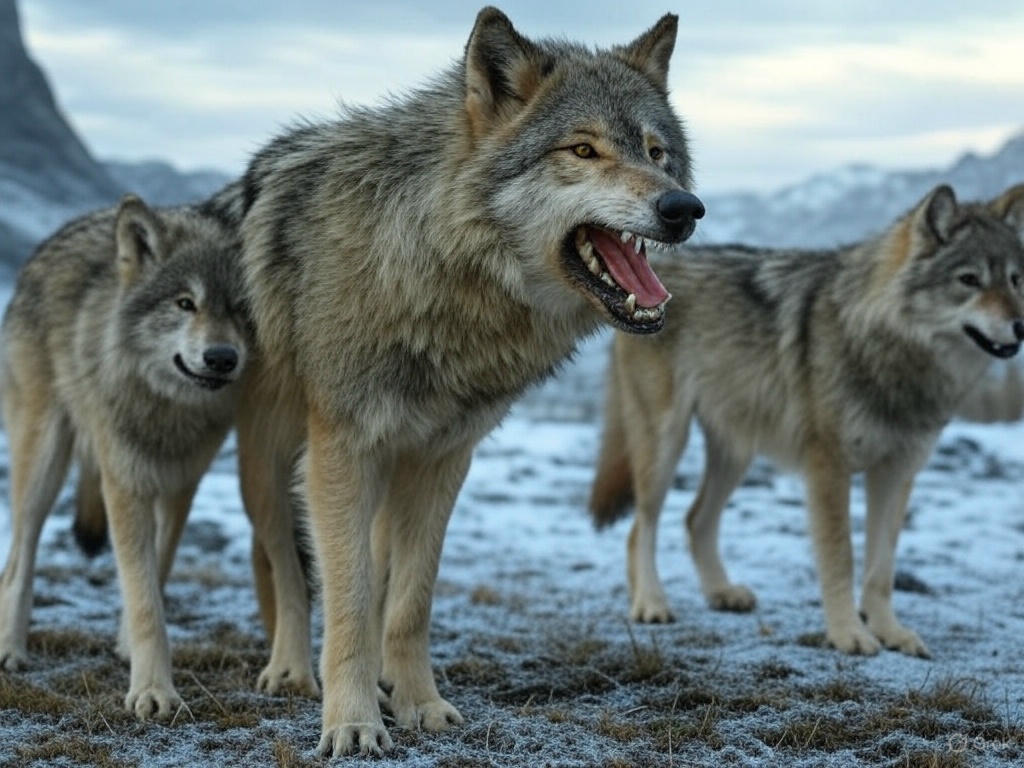
Colossal Biosciences shook the world when they proudly unveiled their latest achievement and showcased three wolf pups born in a “secretive facility” somewhere in the northern US. Romulus, Remus, and Khaleesi are alleged to be the first living subjects of a successful de-extinction experiment.
Romulus, Remus (born October 1, 2024), and Khaleesi (born January 30, 2025)

KHALEESI

REMUS

ROMULUS
This work © 2025 by Colossal Inc is licensed under CC BY-SA 4.0
The group of scientist analyzed the DNA from a 13,000 year old –tooth and another of a 72.000 year-old skull,which allowed them to identify 20 genetic variants unique only to the Dire wolves. Then, using the fragments of ancient DNA recovered from the fossils, the team proceeded to carefully engineer the DNA and inject them into modified Grey wolf cells, which are the closest living descendants of Dire wolves. The cells then were injected into embryos and brought to terms. At first glance, the results evoke the gracious Dire wolf’s formidable legacy; Massive frames, thick pale fur and a presence reminiscent of the ancient beasts that once roamed the Ice Age.
A Closer Look at the Science
The Dire wolf, known scientifically as Aenocyon Dirus or Canis Dirus, was a heavyweight of the prehistoric world, larger and more robust than today’s gray wolves. Its extinction around 12,500 years ago left behind a treasure trove of fossils. Despite the large number of fossils found to day, the DNA degenerates over time, especially over 12 thousand years. Moreover, the team did not create the DNA from scratch, instead, based on reports they altered around 20 genes to mimic some traits of the Dire wolves, focused mostly on physical appearance such as its coat color and body size.
The results of the genetic modification – Romulus and Remus, now 6 months old are undoubtedly greater in size than typical Grey wolves with very dense fur. Khaleesi at two months old also starting to resemble some characteristics of his siblings, however the scientist community argues that creating animals with same or similar traits as an extinct species doesn’t recreate that lost species. Critics explain that the DNA’s of the puppies are still overwhelmingly a Grey wolfs with only a tiny fraction reflecting Dire wolves.
Beth Shapiro (Chief Science Officer of Colossal Biosciences ), described it as creating “functional copies” of dire wolves, not exact genetic replicas, given the pups are 99.9% gray wolf.
Key disputants are experts like Julie Meachen, Nic Rawlence, and Jacquelyn Gill dispute Colossal’s “de-extinction” label. Rawlence argues ancient DNA’s degradation (likened to “shards and dust”) prevents true cloning, making these engineered hybrids, not Dire wolves.
As of April 2025, the resurrection of extinct Dire wolves in their full uniqueness remains a feat beyond current technology. While Colossal Biosciences has pushed the boundaries of what’s possible, and their work marks a significant milestone in genetic engineering, without a complete DNA genome, true cloning remains out of reach, leaving Colossal’s ‘de-extinction’ as little more than an overstated term.

Subscribe to continue reading
Subscribe to get access to the rest of this post and other subscriber-only content.