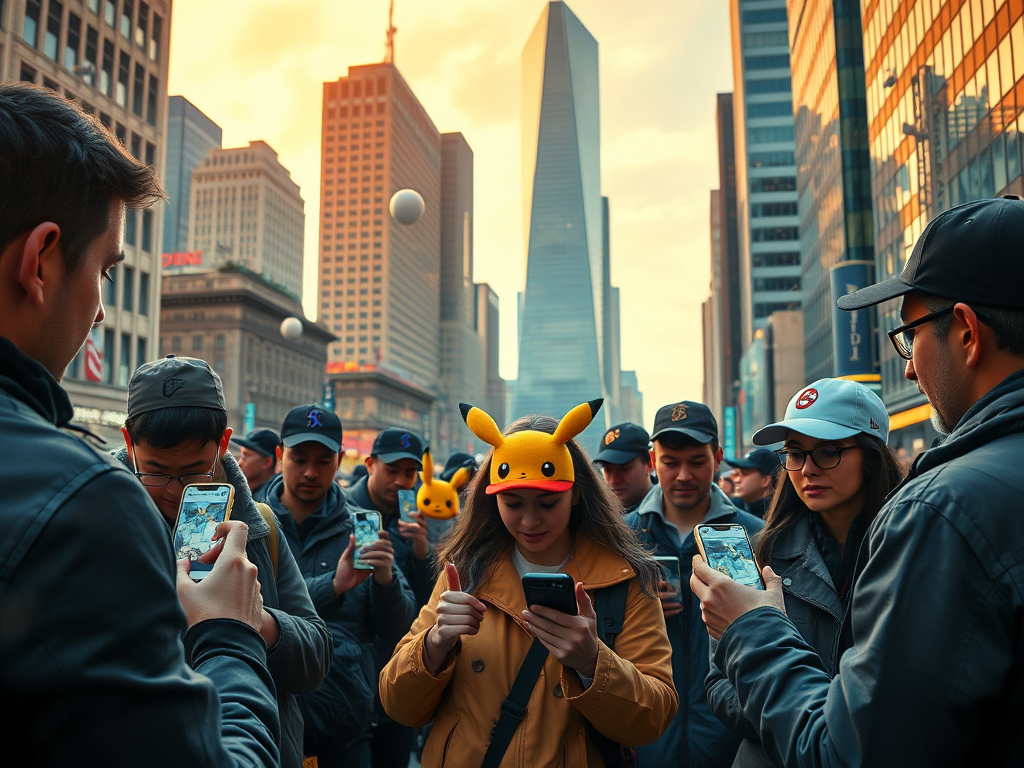






Pokémon Go has became an instant global phenomena upon the app’s launch back in 2016. Players were roaming cities, and remote areas. Millions of users were -some still do to this day- actively searching for rare virtual creatures with their smartphone. However, there have been widespread theories and speculation linking the app to intelligence agencies due to it’s extensive data collection capabilities. Below is an exploration of this theory, it’s origins, and the real concerns about data privacy in augmented reality (AR) games.
Did the CIA Use Pokémon GO for Geo-mapping and Data Gathering?
The app was widely celebrated for it’s innovative ways to encourage psychical activities and social interaction however, shortly after it’s debut, privacy advocates quickly raised concerns pointing to the risks of data collection and share of user data.
One of the persistent theories suggest that Pokémon Go was indeed a tool for the CIA and other intelligence agencies to gather vast amounts of geospatial data and video footage to create the most accurate geospatial map, camouflaged as a game using one of the most well known brand to attract volunteers without their knowledge. Could this be another hoax, with no creditability, or is this the truth? Let’s dive into the origins of this plausible claim.

The Origins of the Theory
This theory might sound incredibly plausible for some, however it is based on creditable evidence and some further speculations. However the legitimacy of the theory should not be entire dismissed before further investigating it’s foundation.
The founder’s Connection to Google
The root of this hypothesis emerges from the shady past of it’s CEO. John Hanke, developer and CEO of Pokémon Go, have previously founded a company called Keyhole, INC. The organization was specialized in geospatial data visualization, however in 2004, Google has acquired the model which later became the foundation of Google Maps. Notably, Keyhole had also received funding from In-Q-Tel, the venture capital arm of the CIA. This connection allowed many to speculate that the developer behind Pokémon Go, Niantic, may have some similar ties to such intelligence agencies.
The Game’s Massive Data Collection Capabilities
To properly experience all the functions the game offers, users are required to log into a google account and give the app permission to access the device’s GPS, Camera, and sensors.
Requirements such as the users location and camera access meanwhile surveying around cities and remote areas while using the app sparked speculations that this data could be used to build detailed maps and a massive real-time surveillance system.
The Gamification of Surveillance
A key aspect to this theory is the is the games ability to incentivize users to survey areas where they would not necessary go, all the while recording their GPS data and sharing real-time video footage. A number of reports surfaced were players were encouraged to wander into restricted areas, such as military bases, polite stations or even government buildings , as well as the use of camera on these locations and these are all places where data collection would typically be restricted, users now voluntarily risk their wellbeing to capture the rare Pokémon’s. These incidents raised suspicion amongst the players and possible observers of the game that intelligence agencies could indeed be using this to collect a massive amount of data all of private spaces camouflaged as a popular mobile game.
Real Privacy Risks with Pokémon GO
Even if Pokémon GO wasn’t a CIA operation, the game still raised valid privacy concerns.
Overreach in Google Account Access
When Pokémon GO first launched, it requested full access to users’ Google accounts, which could theoretically allow Niantic to read emails, documents, and stored files. This was later corrected, but it highlighted potential data security risks.
Location Tracking and Behavioural Insights
Because the game logs where and when players move, this data could be valuable to advertisers, corporations, or even governments. It could reveal movements patterns of large populations, frequently visited locations and even daily routines and habits.
Data Sharing
Niantic’s privacy policy allows it to share data with third parties, including law enforcement if required. This means governments could request user data, though this is true for most apps. however Pokémon Go has been accused of massive data sharing in the past.
How Realistic Is the Theory?
While it is easy to understand the suspicion behind the popular game. There could be some counter-factors that requires consideration.
Niantic’s business model is commercial, and not government backed, meaning that the organization makes money through in-game purchases , merchandises, and sponsorships from other businesses to advertise them in the game. The company’s financial success depends on keeping users engaged, and not on any sort of governmental support.
On another note, the CIA, and NSA already have access to the most accurate satellite imaginary, surveillance programs, and a multitude of tracing technologies, far more advanced than a mobile game could go as of today. When an agency needs geospatial data , they could obtain it through Google maps, cell tower tribulation or existing security infrastructure rather than a publicly available game. However we still can’t completely opt out this opportunity as this would make the process of obtaining these footages far more convenient and less time consuming
Privacy Concerns Are Not Exclusive to Pokémon GO
The type of data Niantic collects is not unique. Google, Facebook, Apple, and other tech giants gather vast amounts of location data through maps, social media check-ins, and fitness apps. If data collection were the real goal, intelligence agencies would have a wide range of ways to access such information.
Final Verdict: Was Pokémon GO a CIA Tool?
The idea that Pokémon GO was secretly a CIA operation is not entirely outlandish. The game collected valuable geospatial and behavioral data, which intelligence agencies known to exploit. The CEO’s past connection to CIA, and previously even received funding from the agency could be considered a direct evidence however there is no concrete evidence that would prove this theory, therefore it it should be considered with a grain of salt.
Rather than being a deliberate intelligence-gathering project, Pokémon GO is an example of how gamification can lead people to voluntarily provide valuable data. The real lesson here isn’t about the CIA but about how modern digital platforms incentivize users to give away personal information—sometimes without a second thought.
If anything, Pokémon GO demonstrates how easy it is to turn data collection into entertainment, a trend that extends far beyond this one game.

Subscribe to continue reading
Subscribe to get access to the rest of this post and other subscriber-only content.