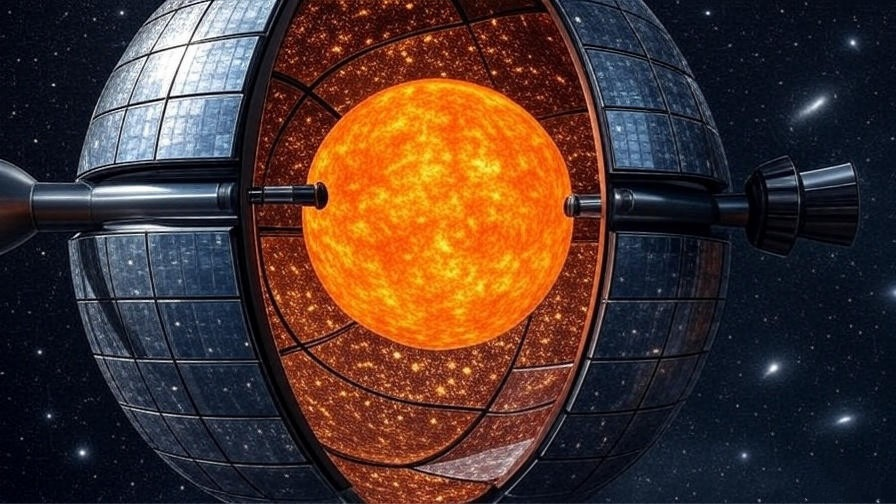
A team of scientists led by Matias Suazo at Uppsala University in Sweden has identified seven potential Dyson Sphere candidates after analyzing a sample of approximately five million stars. The Project Hephaistos II is an attempt to observe and understand these candidates and explore potential signatures of advanced extraterrestrial civilizations through the detection of excess infrared radiation, which is a potential indicator of megastructures like Dyson Spheres.
Dyson Spheres are a theoretical concept that has captured attention for decades—though the idea of harnessing stellar energy dates back even further, arguably to ancient and even biblical times in symbolic form. In modern science, the concept was formally introduced by physicist Freeman Dyson in 1960 as a potential method for detecting advanced extraterrestrial civilizations. He proposed that a sufficiently advanced society might construct a megastructure around its star to capture most or all of its energy output. The study describes Dyson Spheres in a similar way, referring to them as “megastructures that could be constructed by advanced civilizations to harness the radiation energy of their host stars.” A consistent element across the various sources describing the theoretical construction is the presence of a swarm of satellites or panels orbiting around a star, either partially or fully enclosing it. Some sources suggest that, in the case of a fully enclosed star, there could be mechanisms to open and close the dome as needed.


The project is a scientific effort to detect signs of advanced extra terrestrial civilisations. The scientific world believes, that advanced civilisation classifyed as Kardashev Type II, would require an immerse amount of energy to sustain that level of modernization, meaning that they would have to harness their star’s energy through Dyson spheres, megastructures that could absorb starlight and re-emit it as heat, detectable in infrared wavelengths. The scientists leveraging observations from NASA’s GAIA Data Release 3 (GAIA DR3), along with infrared data from the 2 Micron All-Sky Survey (2MASS) and the Wide-field Infrared Survey Explorer (WISE) developed a pipeline to identify candidates with infrared excess not easily examined by natural astrophysical phenomenas, and ended up flagging seven possible M-dwarf start as possible Dyson Sphere candidates that were warranted further analysis.
Ren et al, have conducted a follow up investigation on three of the candidates (A,B,and G) by cross matching their positions with known radio sources in major surveys such as VLASS, RACS, FIRST NVVS and TGSS, and they found positional offsets for candidate A and B -published in 2024 . These findings are not consistent with typical M-dwarfs, suggesting the presence of Dust Obscured Galaxies (DOGs). The author of the study proposes that, due to the density of these DOGs, three of the seven candidates may be contaminated by background sources, potentially resulting in false positives.
Following up in 2025 januarry, a new team of researchers revisited the candidates using new data and attempted to find possible explanations for the phenomena. Using e-MERLIN and EVN (E-VLBI), they zoomed in on the radio source near Candidate G and were able to pinpoint it as VLASS J233532.86–000424.9. They clearly saw that the radio source did not come from the star itself, but rather from three tiny bright spots nearby, which turned out to be radio-loud AGNs—a scientific term for very distant galaxies. These AGNs are hotter than 100 million degrees, which explains the strong radio signal.

With this new insight, Candidate G remains silent, ultimately signaling no advanced life form from there, and leaving six possible Dyson Sphere candidates. The study also emphasizes the need for multi-wavelength, high-resolution vetting of technosignature candidates.
While multiple revisits have helped identify potential causes of false positives and alternative sources of radio signals for candidates A and B—and, in the case of candidate G, clearly traced the signal to a distant galaxy—there remain four M-dwarf stars that continue to raise intrigue. These stars are flagged as possible Dyson Sphere candidates, hinting at the presence of advanced extraterrestrial civilizations. Scientists are still investigating whether the unusual infrared signatures could be explained by more conventional sources, such as dust-obscured galaxies or other natural phenomena. However, for now, these four cases remain unresolved, leaving researchers both puzzled and motivated. No convincing evidence or widely accepted theory has yet emerged to explain them.
If you’re curious about the Search for Extraterrestrial Intelligence (SETI) and want to stay informed on the latest discoveries in astrophysics, subscribe to our newsletter — or dive deeper by visiting the Monthly Notices of the Royal Astronomical Society (MNRAS).

Subscribe to continue reading
Subscribe to get access to the rest of this post and other subscriber-only content.