
A newly founded aerospace company in Dubai has captured global attention after showcasing its groundbreaking rocket engines during the latest hot-fire tests. Both engines—one featuring a conventional bell nozzle design and the other an advanced aerospike—have been designed entirely by Noyron, the company’s uniquely developed Large Computational Model, which, unlike traditional LLMs, operates based on real physical properties and calculations. This innovative approach has been described as the “first AI that builds machines.”
LEAP 71 was founded just two years ago in 2023, specializing in Computational Engineering, autonomous design, and rocket propulsion, aligned with UAE government initiatives for national space ambitions, yet has already catches up to long-established industry giants like NASA and SpaceX with its rapid technological advancements and innovative methodologies in aerospace engineering. The accomplished co-founder, managing director, entrepreneur and aerospace engineer, Josefine Lissner, who has a background in Formula 1 and Porsche Motorsports, personally expressed the company’s key goals, highlighting the timeline rival aerospace companies operate within. She reiterated the great importance of reducing the development timeline from the currently regularized months and years to potential days and weeks, which seems to be clearly illustrated by LEAP 71′s rapid development.
Media of 20 kN aerospike engine © 2025 by LEAP 71 is licensed under CC BY-SA 4.0


After the initial launch, LEAP 71 has managed to maintain a low profile while beginning development. In June 2024, the organization successfully tested its first hot fire 5 kN kerolox (kerosene/LOX) engine, which was designed, printed in copper, and assembled entirely by AI in just two weeks. By December 2024, they had also approved their first 5 kN kerolox aerospike engine and announced plans for scaling by April 2025. By the middle of 2025, they successfully established strategic partnerships with Aspire Space for the line production of Oryx reusable rocket propulsion, all the while further testing and evolving their computational model.
We have all heard of regular language models, including LLMs, which operate on generative content by predicting and generating human-like text through massive dataset training and probabilistic pattern matching. However, Noyron operates on a completely different level compared to generative AIs. It encodes real-world physics such as thermodynamics, fluid dynamics, engineering logic, and even applied physics. After encoding the necessary parameters like the required thrust, propellants, chamber pressure, Noyron uses the data to autonomously synthesize complete geometry via an open-source voxel-based geometry kernel and directly derives the most optimal designs. No manual CAD modeling is needed; once the machine finalizes the designs, the so engineered engines are printed as monolithic structures (single-piece prints) in high-temperature alloys like copper, which enable more intricate internal cooling channels than traditional manufacturing can achieve. Described as “without human intervention,” other than setting the input parameters and encoding the initial physics-engineering knowledge into the model, the process is fully autonomous. While there is still a validation phase that involves running simulations and conducting physical heat tests, these steps will always be necessary for projects of this nature. Currently, the 3D designs are not printed directly by the machine but are instead exported to 3D printing partners such as Nikon and Aconity3D, who carry out the printing, typically completing the construction within three weeks, after which the engines are tested, and feedback is provided to the AI for further improvements.
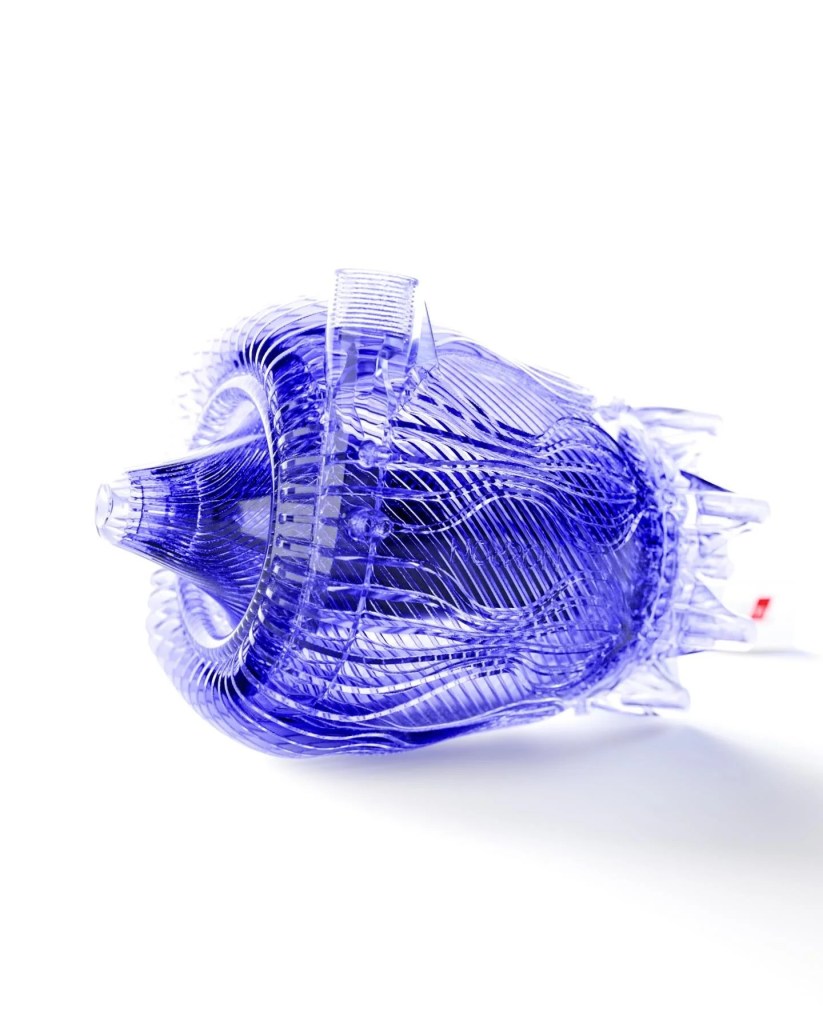
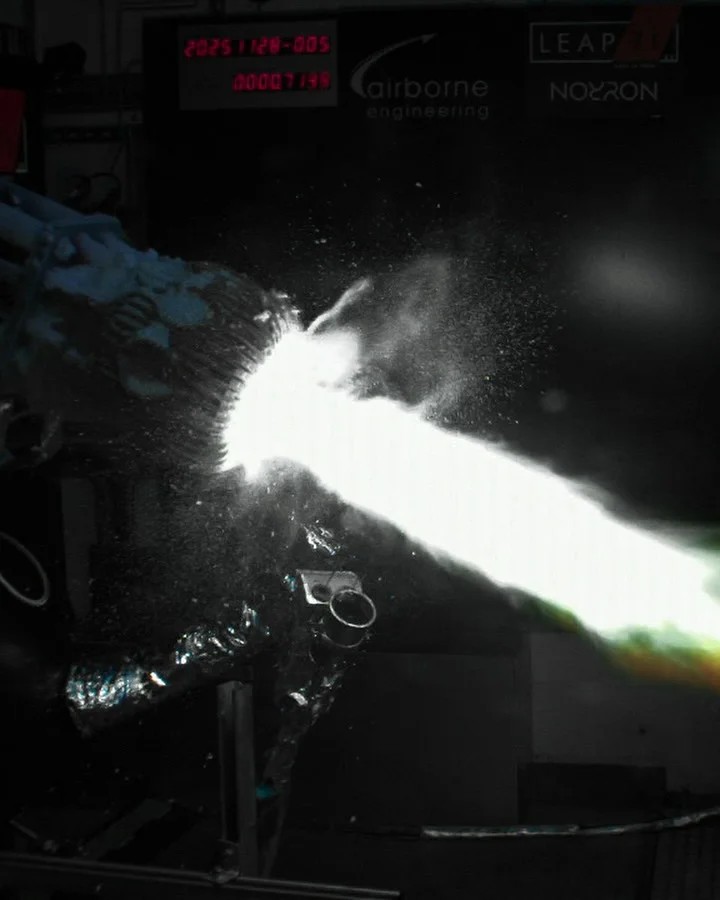
Media of 20 kN aerospike engine © 2025 by LEAP 71 is licensed under CC BY-SA 4.0
LEAP 71‘s goal is to accelerate engine design processes and enable rapid exploration of complex architectures, such as aerospikes, which is clearly reflected in their performance thus far. The organization has already succeeded in testing two 20 kN engines this December (2025) and has now taken the initial steps to accept a 200 kN kerox engine design, showcasing its potential by 2027, which could ultimately achieve breakthroughs for orbital concepts. Additionally, Farsoon Technologies has also requested a fully developed concept for a hypersonic precooler tailored for a single-stage-to-orbit rocket, emphasizing the need for innovative solutions in next-generation aerospace technology.
Wherever LEAP 71 develops the concept of their Large Computational Model, it will undoubtedly revolutionize rocket engineering and space technologies. We can expect more organizations to create their own models to keep pace with the rapid advancements made by Noyron. To stay informed about the latest developments in artificial intelligence and space exploration, subscribe to our newsletter or visit LEAP 71’s official press page for direct updates.

Subscribe to continue reading
Subscribe to get access to the rest of this post and other subscriber-only content.