
Well, as if the people in the United Kingdom are not already depressed enough, totalitarian governments can always find a way take even further! Aria UK’s Advanced Research and Invention Agency has taken the initiative to budget for a £56m investment to dim the sun through a series of experiments in solar geoengineering, including marine cloud brightening to reflect sunlight, all at the expense of the British, Irish, and Welsh populations. Yes, that’s right! The UK government is attempting to lock the half-island out of sunshine for an indefinite amount of time. While the available public information is limited regarding the timeline, the foundations’ roadmap clearly indicates an active initial plan for scaling the project to other countries and suggests that if proven successful, it would continue endlessly, effectively preventing the people from accessing sunshine worldwide!
When we talk about geoengineering, most individuals might associate it with attempts in space exploration aimed at reshaping a planet’s climate system to render it habitable. However, in this context, we would more accurately refer to this process as terraforming. Geoengineering, on the other hand, involves direct and large-scale efforts here on Earth to combat climate change through industrial innovations, resulting in permanent and irreversible changes to our climate.While this might sound contradictory, it is actually the key element in these operations. In an attempt to avoid drastic and permanent changes to Earth’s natural climate, these initiatives aim to directly influence the climate, thereby heating or cooling our planet. Indeed, it is as self-evident as it may seem, so let’s delve deeper into this subject.
Life-Driven Planetary Climate Cycle
As the currently most widely accepted theory, the Mended Hypothesis clearly explains the natural carbon intake and output of our planet. To maintain clarity, let’s focus on an Earth-like planet that has a stable atmosphere, an ozone layer, and is positioned at a suitable distance from its sun—making it habitable. Even such a planet will experience cooler and warmer seasons depending not only on its positioning. The basic carbon cycle is as follows:
Atmospheric carbon dioxide dissolves into clouds and rainwater, forming carbonic acid that weather’s silicate rocks on land, releasing ions that are transported to the oceans. Some of this carbon is sequestered in the oceans through process in carbonate compensation zones. The weathering products that incorporate into rocks are gradually eroded and transported to the oceans via rivers, where along with the rest filtered though these carbonate zones, deposit on the ocean floor as sediments, enriching the oceanic crust (basalt) with carbon. These carbon rich materials on the subduing oceanic plates are carried into the planet’s mantle, where they melt and contribute to magma formation through metamorphic and volcanic processes, leading to volcanic eruptions that release the carbon back into the atmosphere as carbon dioxide. Higher rates of carbon subduction can influence the frequency and intensity of volcanic activity, driven by the carbon content in the magma. Volcanic eruptions typically also cause short term cooling of the planet, as the released aerosols and Ash reflect sunlight in the affected areas.
https://science.nasa.gov/earth/earth-observatory/the-carbon-cycle/

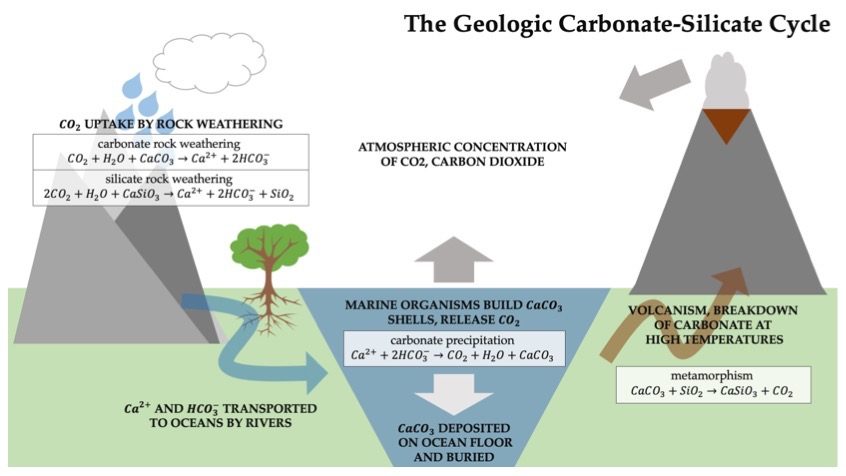
But how does the carbon gets there in the first place, one might ask and rightly so;
If the temperature allows for carbon-based life to develop, the planet will become warmer. This is due to the release of metabolic waste, mainly carbon dioxide, along with a small amount of nitrogenous waste such as ammonia and uric acid when there is available oxygen, and methane (CH4) when there isn’t any oxygen available during digestion and decomposition. Every animal, plant, bacteria, and unicellular organism releases some of these gases during and at the end of their lifetime; this is how carbon is created within a planet. However, this also means that during a flourishing timeline, the more of these carbon-based life forms that are able to multiply, the more carbon will be created, contributing to the greenhouse effect, warming the planet even further and thus creating an environment that is increasingly suitable for the propagation of carbon-based life forms. Yet, when overpopulation is achieved, even just by plants, the planet will become so warm that it becomes unsuitable for most species to live; hence, they will start slowly dying and release even more carbon dioxide due to mass extinction, elevating the temperature even further. While the extinction of these life forms will initially accelerate global warming by reducing carbon sequestration, once the warming reaches its peak, the planet will remain in a hothouse state due to the elevated levels of CO₂ in the atmosphere. Over geological timescales – often millions of years – negative feedback mechanisms will gradually remove the excess CO₂ from the atmosphere, allowing the planet to begin cooling down. With minimal carbon-based life remaining -except bacteria and resilient plants and animals that survive deep in the ocean or underground- the temperature will drop to low levels that challenge surface habitability during this prolonged recovery. Once the CO₂ levels have decreased sufficiently, the planet will start to stabilize, enabling species, bacteria, plants and eventually animals to repopulate and multiply again, thereby closing the carbon-based cycle.
Well, solar engineering, specially stratospheric aerosol injections (SAI) is an attempt to counteract Earth’s natural climate cycle by reflecting more sunlight back into space, reducing the amount of solar energy absorbed by the planet. The proposed method involves releasing tiny reflective particles (aerosols) most commonly sulfur dioxide (SO2) or sulfates into the stratosphere. These particles would scatter, form clouds and increase Earth’s reflectivity (albedo) and mimic temporarily cooling such as seen after major volcanic eruptions. The idea originated from the Mount Pinatubo volcanoes eruption from 1991 which cooled the planet by ~0.5°C for a couple of years by injecting sulfur into the atmosphere
However, this method is currently at the theoretical research stage as of 2026; no definitive positive effects have been confirmed, and only negative effects are currently reported. Nevertheless, the British government is conducting an active experiment by closing off the half island from sunlight. Countries like Mexico, Sweden, and various U.S. states have already banned these experiments due to their immense negative impacts, but the British government remains unconcerned and continues to expose their population to potential harm while conducting this large-scale experimental research that could alter the planet’s carbon cycle forever. The concept overlaps with the chemtrails conspiracy theory, which persists due to airplane trails that were misrepresented to the public as “normal” condensation contrails; however, this is not true, as research shows that nor condensation or kerosene not leaves such trails at all. This situation reflects a large-scale deception aimed at evading scrutiny regarding unaccepted and unverified geoengineering research.
A Troubling 70-Year Legacy: The Dark History of Geoengineering
The concept of intentionally using aerosols in the atmosphere to dim sunlight -now called stratospheric aerosol injection has a surprisingly long history. In the early 1960/70s researchers noticed that volcanic injections form a reflective sulfate aerosol layer in the stratosphere that causes temporarily cooling of the area known as “volcanic winters”. The concept of intentionally using aerosols (tiny particles) in the atmosphere to dim sunlight and cool the planet—now known as stratospheric aerosol injection (SAI) or solar geoengineering—has a surprisingly long history rooted in observations of nature and early climate science.
Soviet climatologist Mikhail Budyko suggested that once global warming became a serious issue, humanity could counteract it by deliberately releasing aerosols into the air to mimic volcanic cooling. He proposed that aircraft should use sulfur mixed with their fuel to burn it and release these particles, thereby creating a reflective layer. In 1991, the eruption of Mount Pinatubo in the Philippines provided real-world evidence of this temporary cooling when it erupted and injected approximately 20 million tons of SO₂, forming aerosols that cooled the planet for somewhat over a year, thereby validating the “volcanic winter” theories. Just a year later, in 1992—while the effects of Mount Pinatubo were still under investigation and not definitive—the U.S. National Academies included SAI in early reports on active geoengineering as a response to climate change, and by the mid-1990s, SAI was formalized as a serious and controversial technology.
By the early 2000s, growing computer modeling of SAI effects has proven an immense amount of negative impacts, such as altered rainfall, ozone depletion, and “termination shock”—referring to the rapid warming once the injections stopped—creating widespread criticism and pre-bans of the technology. Yet, it continues secretly, with multiple independent reports from online forums, radio shows, and later on social media.
The 2000s brought coordinated modeling efforts such as the Geoengineering Model Intercomparison Project (GeoMIP), which tested Solar Radiation Management (SRM) scenarios and further demonstrated its irreversible negative effects. Despite the lack of proven positive outcomes, Harvard’s Solar Geoengineering Research Program, led by David Keith, proposed small experiments involving the release of aerosol particles from airplanes and balloons to study their effects. These proposals were made public and intended to start in 2018; however, bans and public backlash have delayed publicity, resulting in continued secrecy around the research. During this time, international bodies such as the IPCC noted SAI as the most researched solar geoengineering method, indicating that active initiatives were being pursued in spite of its uneven side affect global bans, global backlash and major governance issues.
This very same practice -aerosol trails drawn by airplanes – was told to us taught to us to be nothing else but harmless condense vapor released by the planes while they are burning their fuel, and anyone who suggested otherwise was labelled a toxic conspiracy theorist, however after 70 years of experimenting, the British government finally admitted to it and went full on public. In 2026, the public debate intensifies as active research is publicized without any government or democratic request or acceptance; hence, governments such as the United States and multiple European countries have banned the practice of such engineering. Yet the United Kingdom’s current totalitarian governor stands by this research, having budgeted £56 million for 2025 and proposing an even higher investment by 2026, despite the already proven irreversible side effects, such as rapid global warming once the constant spraying lapses, geohazards like altered rainfall, increased volcanic activities, and other meteorological hazards RFK, the current Secretary of Health and Human Services in the United States, has actively spoken out and taken countermeasures to discredit these initiatives and ban them altogether, stating, “Geoengineering will cause floods and intensified heatwaves,” adding that “we will soon end this crime against humanity” after the British government disclosed their purpose with the large-scale deployment of aerosol airplanes that can be seen circling above England’s skies—take a look for yourself.
For a comprehensive examination of the 2025 debate in the UK Parliament regarding Solar Radiation Management (SRM) geoengineering, including its associated risks, potential harms, and the path towards eventual acceptance, we encourage you to explore the full discussion below.
You can also read the full program, which is primarily funded by Bill Gates and the British Government, concerning the aerosol release here. To stay informed about geoengineering initiatives, subscribe to our newsletter or visit the official site for Initial or Aria by clicking here

Subscribe to continue reading
Subscribe to get access to the rest of this post and other subscriber-only content.